The Accidental Miracle: The Discovery of Penicillin a.k.a Antibiotics
How a forgotten petri dish, a curious scientist, and a decade of persistence reshaped modern medicine.
In the annals of medical history, few events have had as profound an impact on human health as the discovery of penicillin. Often called the first true antibiotic, it transformed how we treat bacterial infections and ushered in a new era in medicine.
Yet this world-changing breakthrough did not begin in a gleaming, meticulously planned high-tech facility. It began with a messy lab bench, a forgotten petri dish, and a scientist who refused to ignore something unusual.
A Chance Encounter with a Mold
The story opens in 1928 at St. Mary's Hospital in London. Scottish bacteriologist Alexander Fleming was studying influenza and working with plates of Staphylococcus bacteria.
Before leaving for a two-week vacation, Fleming left one petri dish uncovered on his workbench. When he returned, he noticed something strange: a blue-green mold had contaminated the plate — and around it was a clear halo where the staph bacteria had been destroyed.
The contaminant was later identified as Penicillium notatum. Fleming deduced that this mold produced a substance that inhibited bacterial growth. He named this mysterious antibacterial compound penicillin.

In 1929, Fleming published his findings in a scientific journal. The paper described penicillin's ability to kill certain bacteria and suggested its possible medical use. However, the compound was unstable and difficult to isolate.
To many of his contemporaries, penicillin was an interesting laboratory phenomenon — nothing more. Funding was scarce, techniques were limited, and the world was not yet ready to bet on a mold that refused to behave reliably in the lab. For nearly a decade, penicillin remained where it started: on the fringes of scientific curiosity.
Turning a Discovery into a Drug
Howard Florey

Ernst Boris Chain

Norman Heatley
In the late 1930s, at the University of Oxford, Florey, Chain, Heatley, and their team revisited Fleming's neglected discovery. Using new techniques and relentless experimentation, they managed to isolate and purify penicillin in a form that could be safely given to animals and humans.
By 1941, early clinical trials on patients with severe bacterial infections showed remarkable results. Infections that once spiraled toward death began to recede. Wounds cleared. Fevers broke. A laboratory curiosity had become a potential life-saving medicine.
War, Industry, and a Lifeline
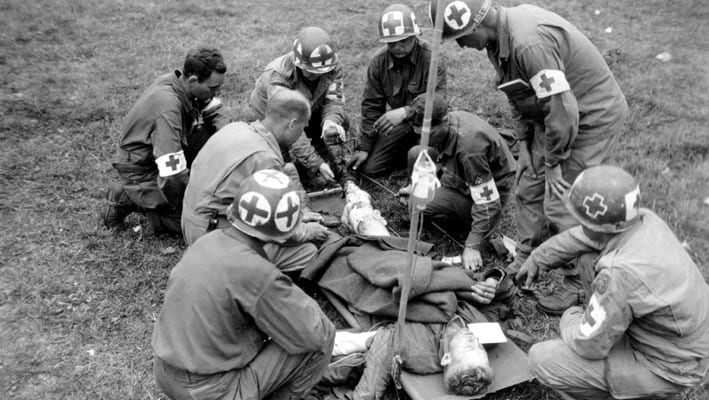
World War II turned penicillin from a promising treatment into a strategic necessity. Battlefield infections — from bullet wounds to shrapnel injuries — were claiming the lives of soldiers even after they survived the initial trauma.
Recognising its potential, the Allied forces partnered with pharmaceutical companies and U.S. scientists to unlock large-scale manufacturing. New fermentation techniques, factory-scale production, and government support meant that by 1944, as the D-Day invasion unfolded, penicillin was being shipped in mass quantities to the front.
Deaths from infected wounds dropped dramatically. Amputations that once felt inevitable could be avoided. Penicillin became more than a drug — it was a quiet weapon reshaping survival in war.
The Birth of the Antibiotic Era
The success of penicillin opened the floodgates. Drug companies and researchers around the world began searching for new antibiotics, each targeting different bacteria. Diseases that had once been devastating — pneumonia, sepsis, syphilis, rheumatic fever — could now be treated quickly and effectively.
The ripple effect was enormous. Surgery became safer. Childbirth became less deadly. Everyday injuries no longer carried the same risk of catastrophic infection. Penicillin changed not just how doctors treated illness, but how they planned procedures and imagined possibilities.
Recognition and a Warning
In 1945, Fleming, Florey, and Chain were awarded the Nobel Prize in Physiology or Medicine for their roles in the development of penicillin.
During his Nobel lecture, Fleming issued a remarkably prescient warning: if penicillin were used carelessly or in insufficient doses, bacteria could become resistant. The miracle could be undone by misuse.
Today, as antibiotic resistance grows into a global health crisis, Fleming's caution feels less like a footnote and more like a prophecy. The miracle of penicillin is powerful — but not invincible.
Legacy of a Moldy Plate
The discovery of penicillin is, at its heart, a story about attention and collaboration. A scientist noticed something odd on a neglected dish and chose curiosity over convenience. Other scientists, years later, saw potential where others had shrugged and did the painstaking work to make it useful for humanity.
What began as a contaminated petri dish became a revolution in medicine — one that has saved millions of lives and continues to do so nearly a century later.
“The accidental miracle of penicillin reminds us that history doesn't only change in moments of grand design — sometimes it turns on a speck of mold, a curious gaze, and the decision to ask, ‘What if this matters?’”